(Applied Physical Chemistry)

(Applied Physical Chemistry)
(b.1964), B.S.(1987,Waseda), Ph.D.(1992, Waseda), Res.Assoc.(1991, Waseda),
Assist.Prof. (1993, Waseda), Assoc.Prof.(1996, Waseda), Visiting Assoc.Prof.(1997,
Stanford).
Shibata Memorial Award, Surface Finishing Society of Japan (1991),
Ando Incentive Prize for the Stidy of Electronics (1997), Sano Award for
Young Scientists, Electrochemical Society of Japan (1999), Award for Young
Scientists, Surface Finishing Society of Japan (1999).
keywords
Functional Surface Chemistry / Electrochemistry / Silicon Wet Device Processes / Scanning Probe Microscopy / Data Storage Devices
Room 65-200
3-4-1 Okubo, Shinjuku-ku, Tokyo 169-8555, Japan
Tel: +81-3-5286-3209
Fax: +81-3-3205-2074
E-mail:t.homma@waseda.jp
Research Interests
The surface of materials possess unique characteristics which potentially may lead to novel functional properties. Our research is directed towards creating nanostructured surfaces and thin films with novel functions at solid-liquid interfaces, evaluating their microstructural and functional properties in nanometer scale, and also analyzing surface reactions in silicon wet device processes, from the view point of physical chemistry.
Our current research involves creating thin films and nanostructured surfaces with novel electronic or magnetic functions, ex-situ and in-situ analyses of their deposition processes and deposition reaction mechanism, performing computer simulation of these processes, developing new methods for evaluating structural and functional properties of the nanostructured surfaces in nanometer scale mainly by scanning probe microscopy (SPM: such as scanning tunneling microscopy (STM), atomic force microscopy (AFM), scanning surface potential microscopy (SPoM), tunneling AFM (TAFM), magnetic force microscopy (MFM)), and applying such surfaces to the development of devices and systems such as high-sensitive sensing devices for X-ray imaging and immunoassay, electrochemical micro reactors, high-density data storage system, as well as atomistic and electrochemical understanding of silicon surface chemistry under device processing conditions.

Fig. SEM image of the microabsorber array for X-Ray imaging sensor device
fabricated by the electrodeposition process.
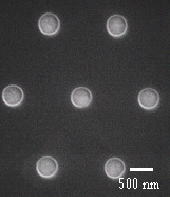
Fig. SEM images for the patterned magnetic nanodots formed by electroless
deposition process.
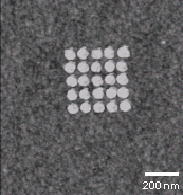
Fig. Representative TMAFM image of Cu nano dot array electrochemically fabricated on the silicon wafer surface.
Representative Publications
(1) "Formation of micro and nanoscale patterns of monolayer templates for position selective immobilization of oligonucleotide using ultraviolet and electron beam lithography", Chem. Lett., 33(2) in press (2004).
(2) "Fabrication of organic monolayer modified ion-sensitive field effect transistors with high chemical durability", Jpn. J. Appl. Phys., 43(1AB), in press (2004).
(3) "High aspect ratio nanovolume glass cell array fabricated by area-selective silicon electrochemical etching process", Proc. IEEE MEMS2004, 258 (2004).
(4) "Molecular orbital study on the reaction process of dimethylamine borane as a reductant for electroless deposition", J. Electroanal. Chem., 559 131 (2003).
(5) "Sn electrodeposition process for fabricating microabsorber arrays for an X-ray microcalorimeter", J. Electroanal. Chem., 559 143 (2003).
(6) "Maskless and electroless fabrication of patterned metal nanostructures on silicon wafers by controlling local surface activities", Electrochim. Acta 48, 3115-3122 (2003).
(7) "Survey of the metal nucleation processes on silicon surfaces in fluoride solutions: from dilute HF to concentrated NH4F solutions", J. Electroanal. Chem., 559, 111 (2003).
(8) "Substrate (Ni)-catalyzed electroless gold deposition from a noncyanide bath containing thiosulfate and sulfite: I. Reaction mechanism", J. Electrochem. Soc., 149, C164 (2002).
(9) "X-ray Absorption spectroscopy on copper trace impurities on silicon wafers", Mat. Res. Soc. Proc., 716, 31 (2002).
(10) "Ab Initio Molecular Orbital Study on the Oxidation Mechanism of Hypophosphite Ion as a Reductant for an Electroless Deposition Process", J. Phys. Chem. B, 105, 1701 (2001).
(11) "Improvement of Signal to Noise Ratio for Co/Pd Multilayer Perpendicular Magnetic Recording Media by Addition of an Underlayer," J. Magn. Magn. Matter., 235, 40 (2001).
(12) "Microstructural Study on the Functionally Graded Magnetic Thin Films Prepared by Electroless Deposition", J. Electrochem.Soc., 146, 160 (2000).
Back to: